
Please pardon another Memorial Day post. While most of what modern storage systems protect are business records there is also the use of storage for saving our cultural heritage – of which this is a small part.
My father, Tom, was an officer in the US Navy Medical Corps during World War II. As a newly commissioned 2nd lieutenant he was aboard a submarine tender anchored at Pearl Harbor on December 7, 1941. As a doctor he spent the next 36 hours in an operating room working on the wounded.
Less than 4 years later he was aboard one of the first US ships to enter Nagasaki’s harbor after the Japanese surrender. In a brief memoir he describes a visit to Okinawa on the way to Tokyo – where he was aboard the USS Missouri when the formal surrender was signed – and then on to Nagasaki, the 2nd city to suffer an atomic bomb attack.
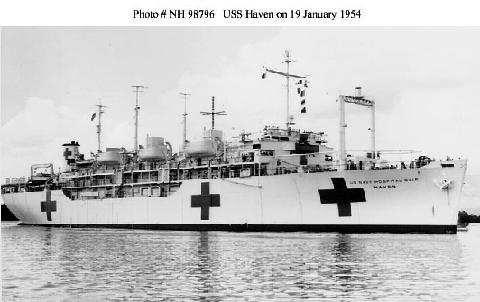
USS Haven, a USN hospital ship, in 1954
The primary mission of the Haven was the collection of Allied POW’s in need of medical care from the many camps in the area.
The trains began arriving every three or four hours each one with several hundred men. Each new arrival was a thrill with the band playing “Hail, Hail the Gang’s All Here” and the sailors and marines on the platform cheering. It was an experience to see the somewhat bewildered expressions of the men on the trains change to tears, smiles and laughter as they realized that they had reached the end of the road – that the day, the longing for which had sustained them through months and years of torture and mistreatment, was at hand.
Update, 10-25-2016: My sister found a photo our father on the train station platform, reviewing the incoming POWs, taken by a Navy photographer. He’s the officer behind and between the two stretcher bearers in the foreground.

Dr. Thomas A. Harris reviewing incoming POWs in Nagasaki.
While in Nagasaki he visited a Japanese hospital:
What we saw in that hospital was something I wouldn’t have missed seeing for anything but something I never want to see again.
Everywhere you looked there were desperately sick people, mostly women and children. Many were horribly burned and over and around all of them were flies by the millions. There were no beds – all patients were lying on straw mats on the floor. In the corridors of the hospital, the patient’s kin had set up their charcoal burners and were preparing a meal thus filling the hospital with smoke. One sensed that death was hovering over many of these people – while we were examining one recent admission, two died close by.
My father soon had his hands full with some very sick POWs.
Within a few days after the released prisoners of war had started arriving at our processing station, my two wards were filled with sick men, many of them living skeletons. Many people thought that it would be only a matter of “resting them up for a couple of days” and giving them plenty to eat. Those of us working with them, however, soon realized that a great many of them were desperately ill and urgent measures were necessary to save them.
But he also got the chance to meet with some of the scientists from the Manhattan project that developed the bomb.
It was our good fortune that the committee sent out by president Truman to study the atomic bomb explosion arrived in Nagasaki soon after we did. They asked to be quartered on board the Haven and inasmuch as I was in charge of the officer’s mess, it was my duty to look after them. As a result I had many interesting discussions regarding the atomic bomb and its possibilities with the members of the committee several of whom were scientists who had worked with the bomb from the beginning. Of course, they gave out no information except what had been released for publication, still it was a thrill to talk with the men who had done much to work it out.
After a lecture by one of the scientists my father concluded:
It may have ended the war for us, but it may some day be turned against us and we would lose the things for which we fought this long bloody war. Our country could be the greatest force for peace and security in the world if it would but accept the responsibility. Even out here few think of anything but getting back and forgetting what they have seen out here. “Let’s get home and look after our own affairs – what these people do out here is none of our business”, they say. And these are intelligent men – it depresses me. We are still selfish and materialistic, we have learned nothing apparently.
Courteous comments welcome, of course. The complete 12 page document – scanned and OCR’d into a PDF – is available here. Scanning from an old typescript is imperfect so there may be errors.
StorageMojo will be back to its regularly unscheduled programming tomorrow.

Thanks very much for these memories on this Memorial Day!
I can’t imagine what my grandparent’s generation lived through — but they could not, perhaps, imagine the international zoo of people that I have lived with, worked with, and consider dear friends.
Let us hope that we can continue the work to make the world better for us all.
This was one of the best memorials I have read today. Thanks Robin! Your insight into the real world is remarkable.
Robin,
Thanks for sharing this, it really makes you put things in perspective.
Lyca
Fascinating and sobering stuff, especially in light of the news that North Korea has tests an A-bomb of very similar yield to the one used at Nagasaki. I sometimes wonder what would have happened if the bombs hadn’t been dropped on Hiroshima and Nagasaki – not, in terms of what would have happened in the resolution of WWII. Opinions vary on that. No, I wonder what would have happend in the forthcoming Cold War. The effects of these two relatively modest A bombs on two Japanese cities were devastating – more so than even the greater loss of life of the fire-bombing of Tokyo, simply because this was just one, single event. Truly a game changer.
Those images were burnt into the consciousness of a a least two generations. The wartime generation and that of mine, born in the decade or two after the war. That post WWII era always had those images and the apocalyptic novels and films that ran through the period. Nevil Shute wrote “On the Beach”, Walter M Milmr jr wrote “A Canticle for Leibowitz” and Stanley Kubrik filmed Dr Strangelove. All the whils there were those images – was it that which stopped the Cuban Missile Crisis running out of control? Was it that which allowed the politicans to reign in General MacArthur in the Korean war?
With the first hand experience of these events fading away, I wonder if “A Canticle for Leibowitz” will prove prescient – that human beings are ultimately unable to control organised agression and that we are bound to repeat our mistakes. The history of conventional warfare rather supports that notion.
Hi Robin…
Thanks for posting this story…it’s really good. My father was on the USS Haven on that voyage to Nagasaki in 1945 – he was a pharmacist mate. To me, it’s interesting to read the various stories of that voyage – I think your dad’s is the best I’ve seen.
An interesting article, thanks for posting it.
My grandad was a British POW liberated from camp Fukuoka #2 on Koyagi Island by Nagasaki in September ’45. He’d been there since October 1942 working in the Kawanami shipyard.
He was 4 miles from the epicentre of the Atomic blast and lived to the ripe old age of 88.
Cheers,
Derek Robertson.
My father Torvald A Kibsgaard was a Norwegian POW liberated from Fukuoka #17 probably the early days of september 1945.
He was working in the coal mines and survived the bomb.
He is 92 yrs old and still has his clear mind from those days. He also was 2 or 3 days onboard this hospital ship before they were sent to Okinawa probably onboard a hangar ship but the name I do not know.
Many thanks
Thore Kibsgaard
I’d like to find Wendy Beaird Harrrison. My father was a corpsman on the Haven. Don’t you think our fathers most likely knew one another? Would love to share your memories and mine. My parents met aboard The Haven- my mother being an RN. My brother and I are the results of that shipboard romance.
Today is the 65th anniversary of VJ day. I am overwhelmed.
Celiane Milner
Thank you for sharing these remarkable memories. My father, Americo “Gooch” Arcamone was a Pharmacist’s Mate on the Haven and was there in Hiroshima and Nagasaki, as well. He was 19 years old. When I was writing my family’s history and got to World War II, I had to stop writing and record my father’s voice in his own words of these amazing life experiences. My Dad is 84 years young and remembers all of this as if it happened yesterday. I am grateful to have it all written down.
Robin
just found this post having today found that my father: S/SGT Robert Paul Aegerter was a Japanese POW having been taken prisoner in Malaya. From there he spent time at Changi, in Singapore, Thailand and final he was shipped to the Island of Kyushu to work in a munitions factory. He said that he had no idea where the stuff they made was going to be used, but he was sure it was never going to work!
He was liberated in Sept 1945 by Allied Forces, I’ve never known who they were but assumed they were American.
From there he went to Nagasaki and would have been one of those men your father saw! (22nd Sept) He was on board when the USS Haven lef,t arriving in the UK on 18th Nov 1945.
Your Dad must have done a good job as he lived on till 2007 aged 94 years If you are able, please thank him for me and my mother; who incidentally will be 100 in June this year.
regards
Chris
My father was Able Seaman Arnold Pickering on HMS Exeter.
He was at Fukuoka #2. I am compiling a family history book and it would be nice to hear from anyone or their relatives who served on Exeter and was in the same camp. Sounds as if Derek Robertson’s grandad was there at the same time and might have known my father.
Be grateful for any info.
Mike Pickering 29 April 2011
I am delighted to find this post even though it is two years old. My father, James G. Burner, served as a medical corpsman on the USS Haven during WW II. He often spoke of the condition of the POW’s and going into Nagasaki itself and the unbelievable destruction.
Daddy was scheduled for submarine duty when an officer found he had had some first aid training during his time with the CCC. As my Dad wasn’t too thrilled at the prospect of sub duty he jumped at the chance to serve on the Haven.
My father passed in 1995. He loved the Haven and spoke of her often and with deep affection until he left us.
Lila Housden
Thank you for this story. My father, Dr Edward Comstock Wilson Jr, also an officer and surgeon with the Naval Medical Corps, was transfered from the USS New Jersey to the USS Haven for the Nagasaki operation. Although my father had a very successful post-war career, he looked back at his service during WWII as the most important and rewarding time in his life. He passed in 1989.
EC Wilson III
Very interesting. My Grandfather was also on the USS Haven when it entered Nagasaki after the bombing. I need to do some more research on this and check to see what kind of information my Grandfather may have left behind. Thanks for the article!
My dad also served aboard the USS Haven during WW II. His name was Petty Officer 2nd, Dick O. Rowe. He described to me the horrible condition of the POWs they picked up in Nagasaki. He said the first day the POWs were allowed to eat in the regular mess with the Haven sailors. The POWs had been starved so when they had the chance to eat onboard the Haven they all cleaned their plates. The sailors, feeling sympathy for them were only too happy to share whatever was on their plates with the POWs. The result–to a man, all of the POWs’ became violently ill. Their systems could not handle the richness and the quantity of the food after being denied decent food for so long by the Japanese. My dad said after that first meal the POWs and the crew of the Haven were not permitted to eat together again. The POWs were only allowed bland food in small quantities at a time until their digestive systems could handle “normal” food again.
My dad also spoke about how the sailors were given the opportunity to tour Nagasaki. The men were loaded onto flat bed trucks and driven all over the area. My dad described breathing the clouds of dust the trucks produced. Of course no one knew anything about radiation and that these sailors were being exposed to high levels of radiation unwittingly. Compared to the planned invasion of Japan, until his dying day, my dad thought the Atomic Bomb was a very good thing that saved thousands of American as well as Japanese lives. Thank you for allowing me to share my dad’s memories of serving onboard the Haven. He lived to be 93, by the way, so fortunately being exposed to that toxic radiation didn’t shorten his life but it was something he always worried about.
My father spent 6 months on a ship and did shore patrol that whole time he was in Nagasaki. They told him he would probably be sterile but he wasn’t . I do know it affected him the rest of his life, he died of complications from Cemo therapy after he had esophageal cancer. I know that anyone there that wasn’t a reporter was not allowed to have a camera. Thank you for the writting about this.
My father served on a Destroyer Escort that accompanied the hospital ship into Nagasaki Harbor. They were allowed ashore but warned not to eat any food or drink any water. He never, ever forgot the sights from that event.
I was one of the original crew and part of the Nagasaki experience. I am 94 years old with some effects of the radiation but still doing what I want to do.
About ten years ago, as I was going through boxes of my late mom’s photos, letters and such, I discovered a letter my father, Francis “Bud” Chapman, wrote to her while he was serving as a CPhM on the USS Haven while they were in Nagasaki. My dad died in 1972 when I was 14, and he never mentioned this to me, probably because he thought we’d have more time. The letter described the horrible physical condition of the POWs and , but also their relief and happiness. It’s one of the regrets of my life, the my dad and I never got to discuss this as men. The letter was very personal and moving, and it made me appreciate my dad’s service even more. Another regret is that I didn’t find this site until today.